
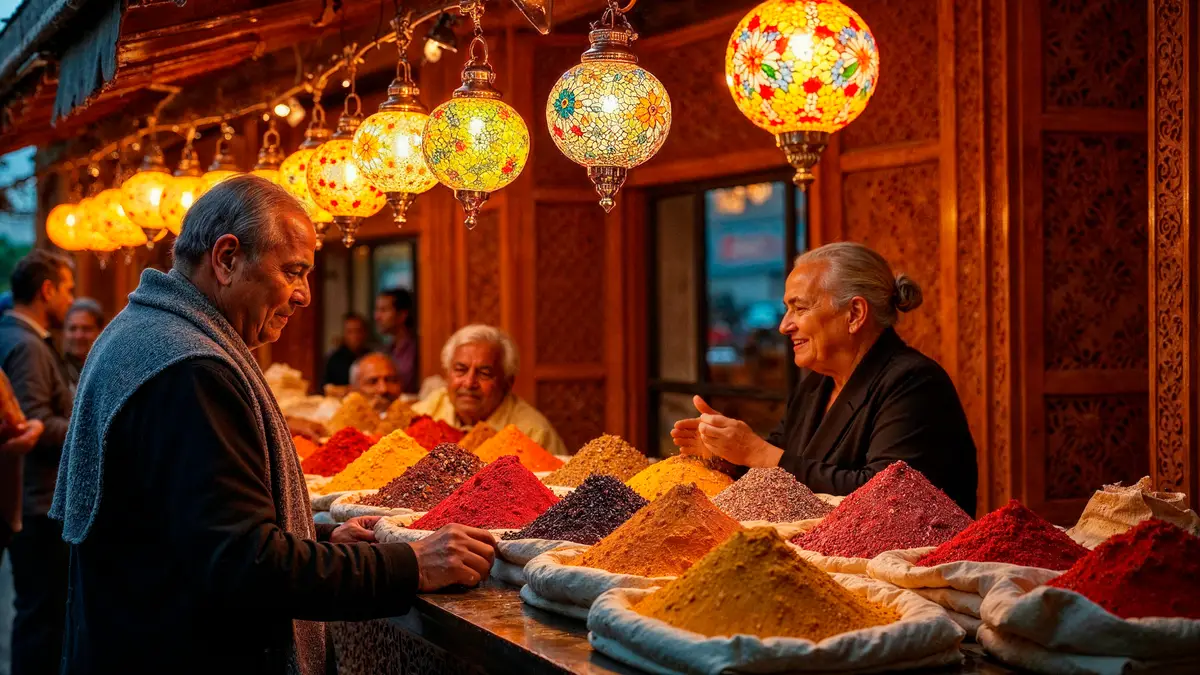
Picture this: you get into a taxi in Cairo or Dubai and, instead of the usual "hello," you tell the driver السلام عليكم (as-salA:mu 'alEykum — "peace be upon you"). A smile flashes in the rear-view mirror at once — and for the whole ride you're treated a little differently. A single phrase in the local language instantly moves you from the "tourist" box into the "one of us" box.
And the best part: you don't need to know Arabic for this. You need just a handful of expressions — the ones that save you in a taxi, at the market, in a café and when you first meet someone. A vendor who hears شكرا (shOkran — "thank you") instead of an English "thank you" breaks into a smile — and sometimes knocks a bit off the price. We've collected thirty phrases that work from day one — in Egypt and in the Gulf alike. Read them aloud: they're simpler than they look.
Say hello and be polite
In the Arab world politeness isn't a formality — it's your entry ticket. Every conversation starts with it, and it's the first thing people notice.
- السلام عليكم (as-salA:mu 'alEykum) — "peace be upon you," the main and most respectful greeting. It works everywhere, from Morocco to Oman.
- وعليكم السلام (wa 'alEykum as-salA:m) — the reply to it, "and peace upon you." Hear the first, answer with this.
- مرحبا (mArhaba) — a simple, neutral, easy "hi."
- صباح الخير (sabAh il-khEyr) — "good morning," literally "a morning of goodness."
- أهلا وسهلا (Ahlan wa sAhlan) — "welcome"; the same words answer someone when you're glad to see them.
- شكرا (shOkran) — "thank you." The single most useful word in your arsenal.
- عفوا ('Afwan) — "you're welcome," and also "excuse me" to get someone's attention.
- من فضلك (min fAdlak) — "please," when you're asking for something.
Eight phrases — and you can already greet, thank and address someone politely. Note that ع in words like عليكم is a deep guttural sound we write as "aa." Don't panic — a couple of weeks of practice and it settles in.
Start a conversation
After a greeting Arabs almost always ask how you are — and expect you to ask back. It isn't an empty formula but a mark of respect: people first, business second.
- "How are you?" sounds different from place to place. In Egypt it's إزيك (izzAyyak, to a man). In the Gulf, the Levant and in Standard Arabic it's كيف حالك (kIf hAlak).
- الحمد لله (il-hAmdu lillA) — "praise be to God." The universal answer to "how are you?" — whether things are great or so-so. You'll hear it a hundred times a day.
- أهلا وسهلا (Ahlan wa sAhlan) again — it's also the reply when you're introduced, literally "you're among your own."
Even if the conversation then slips into English, these three lines set a warm frame. You've shown you respect the local rhythm of talking — and people appreciate it.
At the market and in the café
Here the phrases pay off literally. Markets and cafés are where a tourist overpays while a "local" gets a fair price and an extra bit of attention.
- "How much?" is bikAm in Egyptian. A short word that opens any bit of haggling.
- قهوة — "coffee." And here's your first living dialect difference: in Egypt it's 'Ahwa, in the Gulf it's gAhwa (the letter ق is read there as a hard "g").
- شاي (shAy) — "tea," sounds almost the same everywhere.
- ماء (mA) — "water" in Standard Arabic; in Egypt you'll more often hear مية (mAyya).
- تمام (tamAm) — "great, agreed." A universal yes: to a price, to a meeting time, to anything.
- كويس (kwAyes) — "good" in Egyptian. Answer "how's the coffee?" with كويس and the vendor is pleased.
The first numbers help too, so you can catch a price: واحد (wAhid — "one"), اثنين (itnEyn — "two"), ثلاثة (talAta — "three"). Say "قهوة, واحد, من فضلك" and you'll be understood without a word of English.
The "magic" fillers
Some expressions don't translate directly but run through all of Arabic speech. Knowing them means understanding not just the words but the mood.
- إن شاء الله (inshA' allA) — "God willing." Said about anything in the future: "see you tomorrow, إن شاء الله." It's not a dodge but a sincere part of the worldview.
- يلا (yAlla) — "come on, let's go." A magic little word for every occasion: to hurry, to invite, to get started. It works in every dialect.
- حبيبي (habIbi) — "my dear," a warm form of address. It's used for a friend, a child — and the taxi driver will use it on you. Don't be surprised: it's a sign of warmth, not familiarity.
Drop in يلا or حبيبي at the right moment and the other person smiles: that's how "insiders" talk, not textbooks.
One word, different countries
Here lies the main secret: "Arabic in general" doesn't exist in living speech. The same word sounds different in Cairo and in Riyadh — and the form you choose is exactly what reveals whether you're a "local" or not.
| Meaning | Egypt | Gulf | Levant |
|---|---|---|---|
| "I want" | عايز (Aayez) | أبغى (abgA) | بدي (bEddi) |
| "how are you?" | إزيك (izzAyyak) | شلونك (shlOnak) | كيف حالك (kIf hAlak) |
Show up in Dubai with the Egyptian عايز and you'll be understood (thanks to the movies) — but instantly heard as "not local." One precise أبغى or شلونك, and the attitude shifts. So it's worth learning phrases not as "Arabic in general" but for the specific country you're heading to.
How to learn them so you recall them in the moment
The main mistake is cramming transliteration with your eyes. In the crucial second in a taxi you won't recall letters — you'll recall the sound. So learn phrases with your ears: hear a native say it and repeat aloud until it sits on your tongue.
Take five phrases, listen to each a few times, say them after the speaker, copying the intonation — and a day later they'll surface on their own. Live sound sticks in memory far more firmly than a line of transliteration.
It's the sound that brings a phrase to life. Our translator gives any word across all ten dialects in a native speaker's voice — you can hear how the same قهوة sounds in Cairo ('Ahwa) and in Dubai (gAhwa), and you repeat after the right pronunciation instead of guessing from letters.
What to remember
- Start with politeness: السلام عليكم, شكرا, من فضلك — they open any door.
- Ask "how are you?" and answer الحمد لله — in the Arab world it's people first, business second.
- At the market, "how much?" (bikAm), the drink's name and the first numbers are enough.
- Learn phrases for a specific country: عايز in Cairo, أبغى in the Gulf — the form gives away a "local."
- Listen and repeat aloud instead of memorising with your eyes: it's the sound that stays.
Start with these thirty phrases and your very first live "شكرا" will show you their power. To hear how each one sounds in your country and repeat after a native, drop into our dialect translator; and when you want a systematic conversation, a course for your country will grow these phrases into a real one.
Ready to study for real?
Talkarabicnow materials: a free reading base, Living Egyptian and Gulf — with audio, trainers and self-check tests.