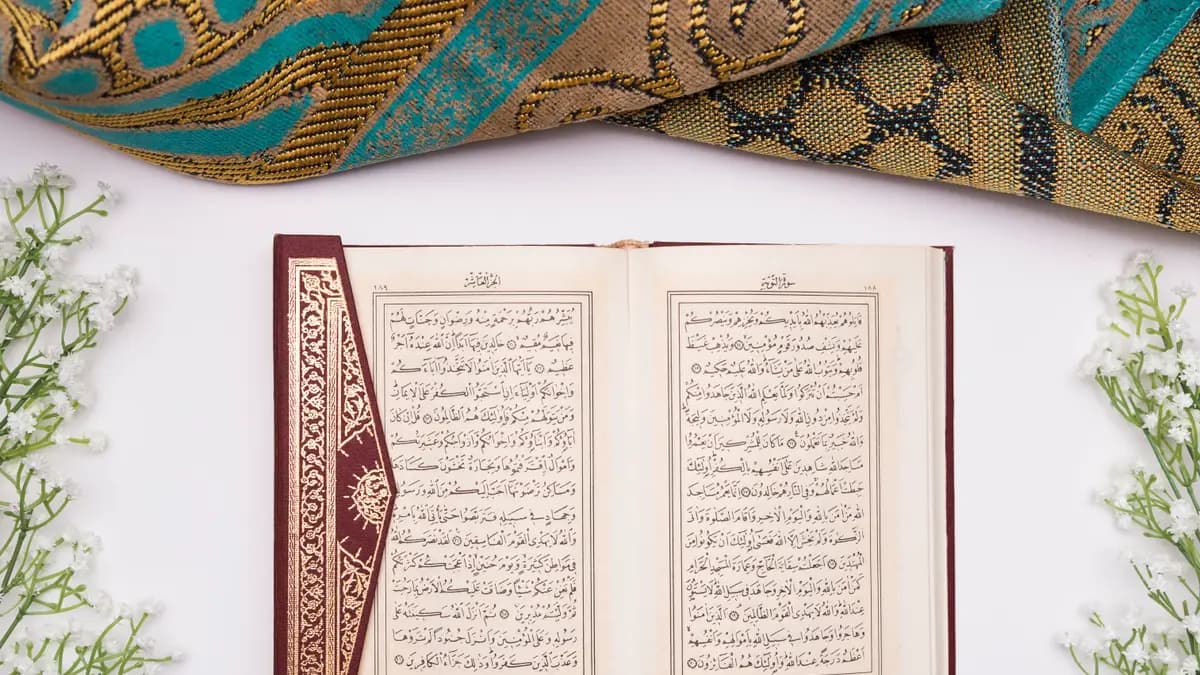
"I'll never manage — it's a cursive script, right to left, 28 unfamiliar letters, and no vowels at all." Almost everyone thinks this the first time they see a line of Arabic: an unbroken pattern with nothing for the eye to grab onto. It looks like it would take years to decode.
Good news: that's an illusion. Arabic writing is surprisingly logical — arguably more logical than English, where the cluster "ough" is read five different ways. In Arabic, you read it as it's written. Letters live in "families" that share a shape. And those scary dots and marks above the line are actually your best friends. Here are five steps that turn the "pattern" into text you read aloud within a couple of weeks.
Step 1. Forget "28 different letters"
The classic beginner mistake is to cram the alphabet one letter at a time, as if it were 28 separate symbols. That's how you drown. The secret: Arabic letters differ not one by one but in groups. Several letters share the very same skeleton and differ only by dots — how many, and whether they sit above or below.
Look at the first family. One hook: put a single dot below and you get ب (ba), two dots above and it's ت (ta), three dots above and it's ث (tha). Three letters in one go. Same story with the "little boat": ج (jim/gim), ح (a deep ha), خ (a raspy kha) — one outline, only the dot changes.
| Skeleton | Letters | What differs |
|---|---|---|
| hook | ب · ت · ث | 1 dot below · 2 above · 3 above |
| boat | ج · ح · خ | dot below · no dot · dot above |
| teeth | س · ش | no dots · 3 dots above |
| "hard" ones | ص · ض | one dot added |
Learn the shape of a group, not the letters, and an alphabet of 28 "strangers" collapses into about a dozen recognisable families. A note on ض (dad) from that last row: its sound barely exists in any other language, and Arabs proudly call their tongue لغة الضاد — "the language of dad." A lovely fact to carry from your very first lesson.
Step 2. Letters change by position — and that helps
The second fear: "the same letter looks different at the start, middle and end of a word — how do I ever memorise that?" It does look slightly different, because letters join into one continuous line, as if written in a single stroke.
But don't panic, for three reasons. First, there are at most four forms, and they're recognisable — not new letters, just variants of one. Second, the core of the letter (that skeleton with its dots) stays put; only the tails and connecting strokes flex. Third, and most importantly, that connectedness is exactly what makes Arabic fast and beautiful to write — the pen barely leaves the paper. What looks like a difficulty is really a shortcut.
Step 3. Vowel marks are your "training wheels"
Now, about "Arabic without vowels." That's a half-truth. Long vowels are right there in the script — carried by the letters ا, و, ي. Short vowels are shown by tiny marks above and below the letters — harakat. A stroke above means "a," below means "i," a little loop means "u."
Adult books and newspapers usually leave harakat out: a native reader already knows how the word sounds, the way we read English "read" (present) and "read" (past) from context. But for a beginner, voweled text is a genuine lifeline: with it you read a word exactly as it sounds, guessing at nothing. They are, quite literally, the training wheels on a bicycle.
Start with voweled text and always read it out loud. Within a couple of weeks your eye will start filling in the short vowels on its own — and "adult" text without marks stops being scary. That's the very principle our free reading course is built on: wheels first, then off they come.
Don't chase unvoweled "adult" script from day one — it arrives on its own, the way a cyclist's sense of balance does.
A little wonder: sun and moon letters
Before we move on, here's the insight that makes people fall for Arabic. The definite article is ال (al-), a prefix stuck to a word. But it isn't always pronounced the same way.
Compare two words. "Sun" is شمس (shams). With the article it's written الشمس, yet it's read not "al-shams" but "ash-shams": the ل seems to melt into the next sound. Meanwhile "moon," قمر ('amar), with the article القمر is read honestly, "al-'amar."
The letters that swallow the ل of the article are called sun letters (after "shams"); the rest are moon letters (after "'amar"). No mysticism: the language simply adjusts the sound to make it smoother and prettier to say. Once you grasp things like this, Arabic stops feeling like a wall of arbitrary rules and becomes a living, logical organism.
Step 4. Read right to left — but numbers left to right
An Arabic line runs right to left: you open the book "from the end" and sweep your eyes from the right edge to the left. You get used to it in a day or two — a bit like moving to a car with the steering wheel on the other side.
Here's a fun trap, though: numbers inside Arabic text are written and read left to right, in the order you already know. So a single line carries two directions at once. That's the one thing you adapt to separately — and it, too, becomes automatic fast. By the way, in Egypt and the Gulf you'll meet not our familiar digits but Eastern Arabic ones: ٠١٢٣٤٥٦٧٨٩ — that's 0 1 2 3 4 5 6 7 8 9. A few are recognisable, and you'll learn the set in a single evening.
Step 5. Read real words, not tables
The last and most important step. A letter table gets boring fast and barely sticks — the brain has nothing to hold onto, there's no meaning in it. Meaning, on the other hand, grips like glue. The moment you've learned a few letters, start building real words out of them.
Watch how it works. You already know ب and ت — which means you can read بيت (beyt — "house"). Add a couple of neighbours and there's بنت (bint — "girl, daughter"). And كتاب (kitA:b — "book")? The colon in the transcription tells you the vowel is long, drawn out. Each such word is a small victory: you didn't cram a table, you read a real Arabic word. Those micro-victories are exactly what keep your motivation alive at the start.
In short: where to start today
- Learn letter groups by shape, not 28 symbols one by one.
- Don't fear a letter's different forms: they're variants of one; the skeleton stays.
- Take voweled text and read it aloud — with the training wheels on.
- Get used to the direction: lines right to left, numbers left to right.
- As soon as you know a few letters, read real words, not tables.
That's exactly how our free "Arabic Reading & Writing" course works. Letters arrive not in a heap but in logical groups. Every module comes with "magic texts," where the letters you've learned have already assembled into real Arabic words, plus a trainer and a mini-test to lock it in. Two calm weeks at fifteen minutes a day — and you're reading your first words aloud, without fear and without cramming. Start today: that "pattern" turns out to be far kinder than it looked.
Ready to study for real?
Talkarabicnow materials: a free reading base, Living Egyptian and Gulf — with audio, trainers and self-check tests.